
In silico comparative study of substituted xanthone derivatives with hydrazone, ester, and ether groups as antituberculosis agents
DOI:
https://doi.org/10.29303/aca.v9i1.281Keywords:
Xanthone, LigPlot , Antituberculosis, Ligand, DockingAbstract
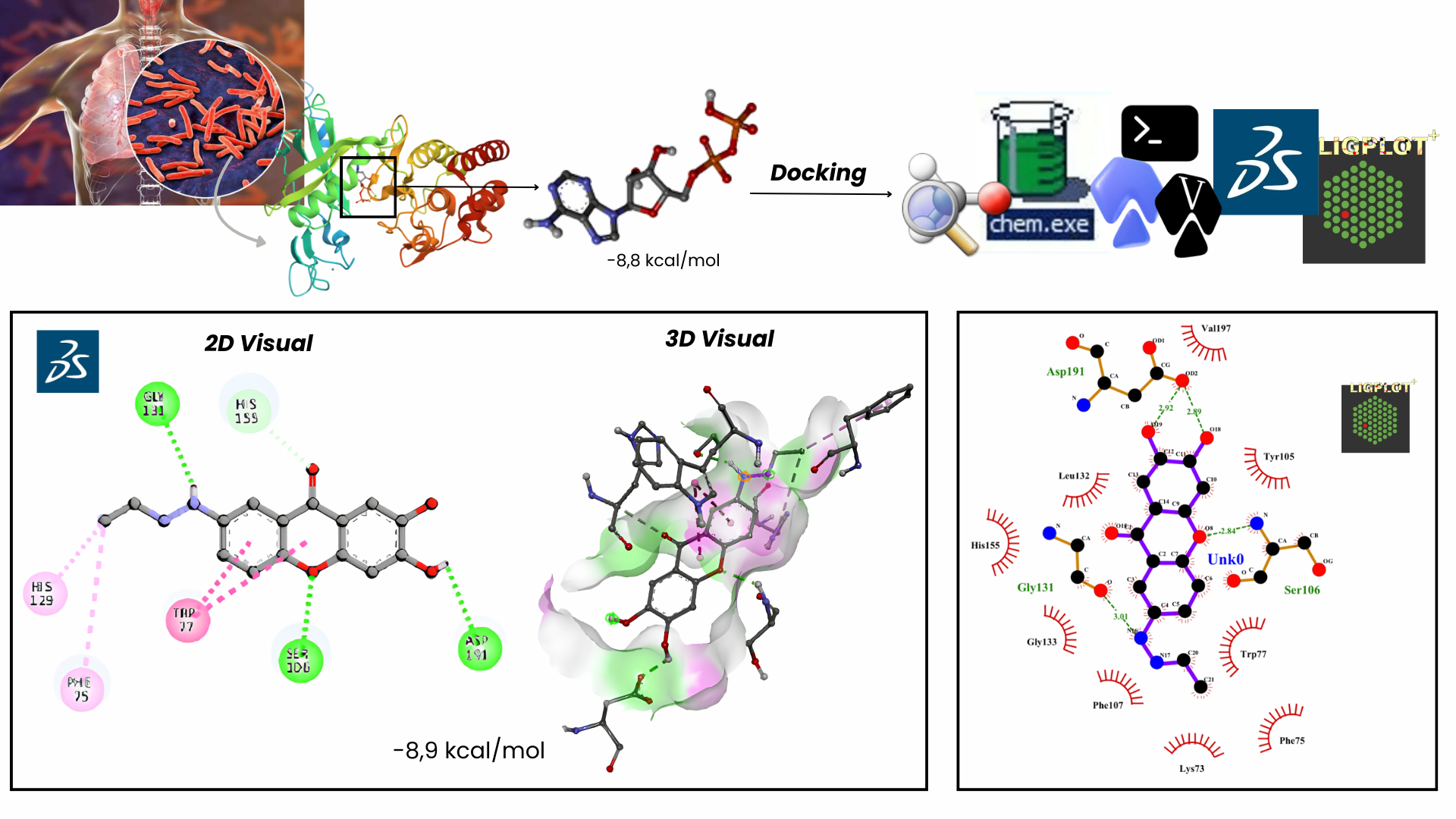
Tuberculosis (TB) remains a major global health challenge, particularly due to the increasing emergence of multidrug-resistant (MDR) and extensively drug-resistant (XDR) strains of Mycobacterium tuberculosis. The discovery of novel antituberculosis agents with new mechanisms of action is therefore urgently needed. Xanthone derivatives have attracted considerable attention due to their broad range of biological activities, including antibacterial and antituberculosis effects. This study aimed to evaluate the potential of xanthone derivatives as inhibitors of serine/threonine protein kinase (PknG) of M. tuberculosis through an in silico molecular docking approach. The crystal structure of the target protein (PDB ID: 4Y0X) was obtained from the Protein Data Bank and prepared using Chimera and Discovery Studio. Ligand structures were designed and optimized using ChemDraw, HyperChem, and GaussView, and molecular docking was performed using AutoDock Vina. The binding interactions were analyzed using LigPlot+ to identify key amino acid residues involved in ligand–protein interactions. The docking results showed that Hydrazone-Xhantone exhibited the highest binding affinity toward PknG as a value of –8.9 kcal/mol, which was slightly better than native ligand (–8.8 kcal/mol). Hydrazone-Xhantone formed stable hydrogen bonds with key active site residues, including SER106, GLY131, and ASP191, with bond lengths ranging from 2.06 to 2.16 Å. Other candidates showed lower binding affinities and fewer stabilizing interactions. The results indicate that Hydrazone-Xhantone has promising potential as a PknG inhibitor and may serve as a lead compound for further antituberculosis drug development. This study highlights the usefulness of molecular docking as a preliminary screening tool in the rational design of new antituberculosis agents.
Downloads
References
[1] Oktarini, S., & Hardisman, H. (2025). Analisis Kebijakan Kesehatan terhadap Supervisi Program Tuberkulosis di Indonesia: Suatu Tinjauan Literatur Sistematik. Jurnal Kesehatan Saintika Meditory, 8(2), 266-280.
[2] World Health Organization. (2022). Global Tuberculosis Report 2022: Fact Sheet.
[3] Anand, R. (2018). Identification of potential antituberculosis drugs through docking and virtual screening, Interdisciplinary Sciences: Computational Life Sciences, 10(1), 419-429.
[4] Rafflesia, U. (2014). Model penyebaran penyakit tuberkulosis (TBC). Jurnal Gradien, 10(2), 983-986.
[5] Sari, R. P. & Arisandi, R. D. (2018). Faktor-faktor yang Berhubungan dengan Kejadian Penyakit TB Paru di Wilayah Kerja Puskesmas Walantaka. Jurnal Ilmu Kesehatan Masyarakat, 7(01), 25-32.
[6] Cui, K., Zhao, X., Liu, W., & Bai, L. (2025). Global, Regional, and National Burden and Trends of Multidrug-Resistant Tuberculosis And Extensively Drug-Resistant Tuberculosis In Adolescents and Adults Aged 15–49 Years From 2010 To 2021: Insights From The Global Burden Of Disease Study 2021. BMC Medicine, 23(1), 445.
[7] Lukas, K., Dang, M. T., Necas, C., & Venketaraman, V. (2025). Anti-TB Drugs for Drug-Sensitive and Drug-Resistant Mycobacterium tuberculosis: A Review. Current issues in molecular biology, 47(9), 776.
[8] Huang, Q., Wang, Y., Wu, H., Yuan, M., Zheng, C., & Xu, H. (2021). Xanthone glucosides: Isolation, bioactivity and synthesis. Molecules, 26(18), 5575.
[9] Yuanita, E., Sudirman, S., Dharmayani, N. K. T., Ulfa, M., & Syahri, J. (2020). Quantitative structure–activity relationship (QSAR) and molecular docking of xanthone derivatives as anti-tuberculosis agents. Journal of Clinical Tuberculosis and Other Mycobacterial Diseases, 21(1), 100203.
[10] Shtyrlin, N. V., Khaziev, R. M., Shtyrlin, V. G., Gilyazetdinov, E. M., Agafonova, M. N., Usachev, K. S., Islamove, D. R., Klimovitskii, A. E., Vinogradova, T. I., Dogonadze, M. Z., Zabolotnykh, N. V., Sokolovich, E. G., Yablonskuy, P. K., & Shtyrlin, Y. G. (2021). Isonicotinoyl hydrazones of pyridoxine derivatives: Synthesis and antimycobacterial activity, Medicinal Chemistry Research, 30, 952-963.
[11] Jumina, J., Mutmainah, M., Purwono, B., Kurniawan, Y. S., & Syah, Y. M. (2019). Antibacterial and antifungal activity of three monosacchari demonomyristate derivatives. Molecules, 24(20), 3692.
[12] Li, S., & Jin, H. (2025). Synthesis, Antibacterial Evaluation and Molecular Modeling of Novel Chalcone Derivatives Incorporating the Diphenyl Ether Moiety. Molecules, 30(12), 2575.
[13] Noviardi, H., Masaenah, E., & Ramadhan, R. (2020). Penapisan molekular kandidat obat sintetik tuberkulosis terhadap protein tirosin kinase Mycobacterium tuberculosis Jurnal Farmamedika (Pharmamedika Journal), 5(2), 60-69.
[14] Chen, D., Ma, S., He, L., Yuan, P., She, Z., & Lu, Y. (2017). Sclerotiorin inhibits protein kinase G from Mycobacterium tuberculosis and impairs mycobacterial growth in macrophages. Tuberculosis, 103, 37-43.
[15] Sinha, S., Sarma, P., Sehgal, R., & Medhi, B. (2017). Development in assay methods for in vitro antimalarial drug efficacy testing: a systematic review, Frontiers in pharmacology, 8(1), 754.
[16] Amin, S., Wihdatunnisa, I., Aisyah, R., & Kurniawan, Y. S. (2024). Potensi senyawa kuersetin sebagai antikanker payudara melalui pendekatan molecular docking, Jurnal Ilmu Medis Indonesia, 4(1): 41–51.
[17] Hidayati, A. R., Widyawaruyanti, A., Ilmi, H., Tanjung, M., Widiandani, T., Syafruddin, D., & Hafid, A. F. (2020). Antimalarial activity of flavonoid compound isolated from leaves of Artocarpus altilis. Pharmacognosy Journal, 12(4): 835-842.
[18] Pratama, M. R. F. (2016). Studi Docking Molekular Senyawa Turunan Kuinolin terhadap Reseptor Estrogen-α (Molecular Docking Study of Quinoline Derivatives Towards Estrogen-α Receptor), Jurnal Surya Medika, 2(1), 1-7.
[19] Setiawan, H., & Irawan, M. I. (2017). Kajian pendekatan penempatan ligan pada protein menggunakan algoritma genetika, Jurnal Sains dan Seni ITS, 6(2): A68-A72.
[20] Elshakre, M. E., Noamaan, M. A., Moustafa, H., & Butt, H. (2020). Density Functional Theory, Chemical Reactivity, Pharmacological Potential and Molecular Docking of Dihydrothiouracil-Indenopyridopyrimidines with Human-DNA Topoisomerase II. International Journal of Molecular Sciences, 21(4), 1253.
[21] Aziz, A., Andrianto, D., & Safithri, M. (2022). Molecular Docking of Bioactive Compounds from Wungu Leaves (Graptophyllum pictum (L) Griff) as Tyrosinase Inhibitors. Indonesian Journal of Pharmaceutical Science and Technology, 9(2), 96-107.
[22] Rastini, M. B. O., Giantari, N. K. M., Adnyani, K. D., & Laksmiani, N. P. L. (2019). Molecular docking aktivitas antikanker dari kuersetin terhadap kanker payudara secara in silico. Jurnal Kimia, 1(1), 180-18
Downloads
Published
How to Cite
Issue
Section
License
Copyright (c) 2026 M. Ibnu Sabil, Anggi Wilian Namira; Naufalika Dzahabiyyaa; Diah Miftahul Aini, Emmy Yuanita

This work is licensed under a Creative Commons Attribution-NonCommercial-ShareAlike 4.0 International License.
Authors who publish with ACA: Acta Chimica Asiana agree to the following terms:
- Authors retain copyright and grant the journal right of first publication with the work simultaneously licensed under a Creative Commons Attribution-NonCommercial-ShareAlike 4.0 International License. This license allows authors to use all articles, data sets, graphics, and appendices in data mining applications, search engines, web sites, blogs, and other platforms by providing an appropriate reference. The journal allows the author(s) to hold the copyright without restrictions and will retain publishing rights without restrictions.
- Authors are able to enter into separate, additional contractual arrangements for the non-exclusive distribution of the journal's published version of the work (e.g., post it to an institutional repository or publish it in a book), with an acknowledgement of its initial publication in ACA: Acta Chimica Asiana.
- Authors are permitted and encouraged to post their work online (e.g., in institutional repositories or on their website) prior to and during the submission process, as it can lead to productive exchanges, as well as earlier and greater citation of published work (See The Effect of Open Access).



 Indonesian Chemical Society, Chapter Nusa Tenggara. Jalan Majapahit 62 Mataram, University of Mataram, 83125, Indonesia