
New-onset diabetes after covid-19: mechanisms, metabolic implications, and clinical insights
DOI:
https://doi.org/10.29303/aca.v9i1.248Keywords:
COVID 19 , Diabetes, Metabolic, Mechanisms, Implications, Clinical Insights , Corona Viruse , 2 (ACE2) recepto , COBAS system , SARS-CoV-2Abstract
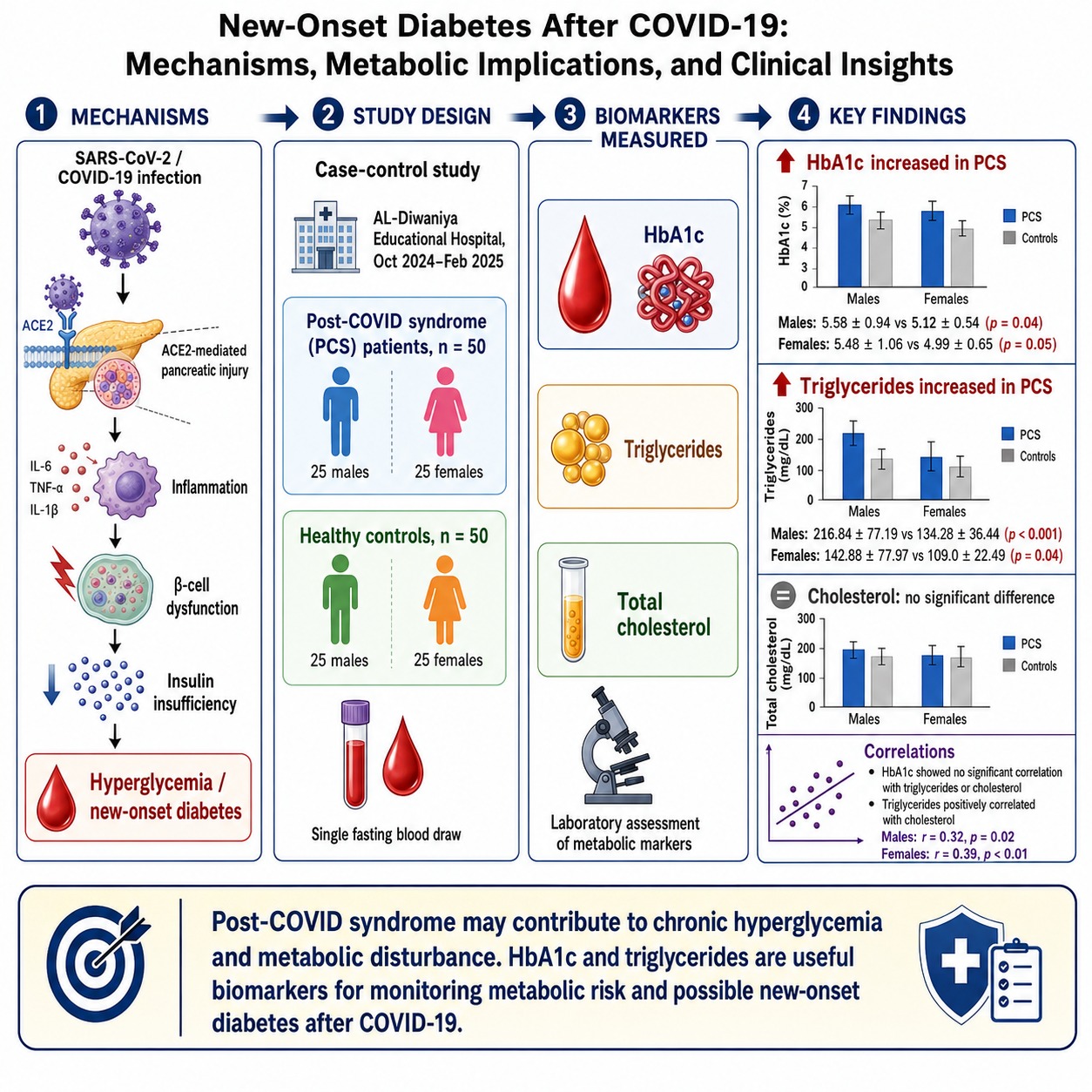
COVID-19 primarily affects the lungs, the impact of COVID-19 is not limited to the lungs only, but rather extends to affect other organs and body systems resulting in other complications that continue during the period of infection or beyond that. New onset diabetes and hyperglycemia is one of the complications of this virus. This study aims to investigate some biomarkers (HbA1c, triglycerides and cholesterol) in group of patients with post covid-19 syndrome and patient with post covid-19 hyperglycemia. Blood samples were withdrawn from 100 (50 controls including 25 males and 25 females and 50 patients including 25 males and 25 females) to investigate HbA1c, triglycerides and cholesterol levels. The result of the present study show that HbA1c significantly increased in PCS males (p.value=0.04) and in PCS females (p.value=0.05) in comparison with control males and control females respectively. The results also show that triglycerides have a significant elevation in PCS males (p.value=0.00) and PCS females(p.value=0.04) in comparison with control males and control females respectively. In the other hand cholesterol was non-significant in both groups. Correlation studies also included and show that there is no significant correlation between HbA1c and other measured parameters. Correlation studies also show that Triglycerides had a strong positive correlation with cholesterol in both PCS groups. Post COVID-19 hyperglycemia is a public health problem in concern and affect the body’s biochemical markers such as HbA1c and triglycerides reflecting their importance in monitoring the overall health in this group of patients.
Downloads
References
[1] Yang, L., et al., COVID-19: immunopathogenesis and Immunotherapeutics. Signal transduction and targeted therapy, 2020. 5(1): p. 128.
[2] Jin, Y., et al., Virology, epidemiology, pathogenesis, and control of COVID-19. Viruses, 2020. 12(4): p. 372.
[3] Mohamadian, M., et al., COVID‐19: Virology, biology and novel laboratory diagnosis. The journal of gene medicine, 2021. 23(2): p. e3303.
[4] Goyal, R., et al., Comparative highlights on MERS-CoV, SARS-CoV-1, SARS-CoV-2, and NEO-CoV. EXCLI journal, 2022. 21: p. 1245.
[5] Alshawi, A. and A.F. Al-Shukry, Increases Aspartate Aminotransferase Activity Negatively Correlated with D-Dimer in Early Diagnosed SARS-CoV-2 Patients. Pharmacophore, 2021. 12(5-2021): p. 85-91.
[6] Perrotta, F., et al., Severe respiratory SARS-CoV2 infection: Does ACE2 receptor matter? Respiratory medicine, 2020. 168: p. 105996.
[7] Metwally, A.A., et al., COVID-19–induced new-onset diabetes: trends and technologies. Diabetes, 2021. 70(12): p. 2733-2744.
[8] Chee, Y.J., S.J.H. Ng, and E. Yeoh, Diabetic ketoacidosis precipitated by Covid-19 in a patient with newly diagnosed diabetes mellitus. Diabetes research and clinical practice, 2020. 164: p. 108166.
[9] Fadini, G.P., et al., Newly-diagnosed diabetes and admission hyperglycemia predict COVID-19 severity by aggravating respiratory deterioration. Diabetes research and clinical practice, 2020. 168: p. 108374.
[10] Rubino, F., et al., New-onset diabetes in Covid-19. New England Journal of Medicine, 2020. 383(8): p. 789-790.
[11] Ben Nasr, M., et al., Indirect and direct effects of SARS-CoV-2 on human pancreatic islets. Diabetes, 2022. 71(7): p. 1579-1590.
[12] Gandikota, S., K.S. Sudha, and M.L. Naramalli, Study of HbA1c levels in non-diabetic individuals recovered from Covid-19. Journal of Family Medicine and Primary Care, 2023. 12(11): p. 2727-2732.
[13] Al-Jubury, K., et al., D-dimer and HbA1c levels findings in COVID-19 Iraqi patients. Brazilian Journal of Biology, 2023. 84: p. e266823.
[14] Ebrahimi, K.H. and J.S. McCullagh, A lipidomic view of SARS-CoV-2. Bioscience Reports, 2021. 41(8): p. BSR20210953.
[15] Fijen, L.M., et al., Severe acquired hypertriglyceridemia following COVID-19. BMJ Case Reports CP, 2021. 14(11): p. e246698.
[16] Durrington, P., Blood lipids after COVID-19 infection. The Lancet Diabetes & Endocrinology, 2023. 11(2): p. 68-69.
[17] Xu, E., Y. Xie, and Z. Al-Aly, Risks and burdens of incident dyslipidaemia in long COVID: a cohort study. The Lancet Diabetes & Endocrinology, 2023. 11(2): p. 120-128.
[18] Almulla, A.F., et al., Elevated Atherogenicity in Long COVID: A Systematic Review and Meta-Analysis. medRxiv, 2025: p. 2025.01. 06.25320068.
[19] Roccaforte, V., et al., Altered lipid profile in patients with COVID-19 infection. Journal of Laboratory and Precision Medicine, 2021. 6.
Downloads
Published
How to Cite
Issue
Section
License
Copyright (c) 2026 Emad Al-Mulla, Baneen Sarhan Al-Bederi, Abtisam Faris Al-Shukry

This work is licensed under a Creative Commons Attribution-NonCommercial-ShareAlike 4.0 International License.
Authors who publish with ACA: Acta Chimica Asiana agree to the following terms:
- Authors retain copyright and grant the journal right of first publication with the work simultaneously licensed under a Creative Commons Attribution-NonCommercial-ShareAlike 4.0 International License. This license allows authors to use all articles, data sets, graphics, and appendices in data mining applications, search engines, web sites, blogs, and other platforms by providing an appropriate reference. The journal allows the author(s) to hold the copyright without restrictions and will retain publishing rights without restrictions.
- Authors are able to enter into separate, additional contractual arrangements for the non-exclusive distribution of the journal's published version of the work (e.g., post it to an institutional repository or publish it in a book), with an acknowledgement of its initial publication in ACA: Acta Chimica Asiana.
- Authors are permitted and encouraged to post their work online (e.g., in institutional repositories or on their website) prior to and during the submission process, as it can lead to productive exchanges, as well as earlier and greater citation of published work (See The Effect of Open Access).



 Indonesian Chemical Society, Chapter Nusa Tenggara. Jalan Majapahit 62 Mataram, University of Mataram, 83125, Indonesia