
Kombucha tea from ambarella fruit as a natural antibacterial agent against Escherichia Coli and Staphylococcus aureus
DOI:
https://doi.org/10.29303/aca.v8i2.257Keywords:
Antibacterial, Kombucha Tea, Kedondong Fruit, E. coli, S. aureusAbstract
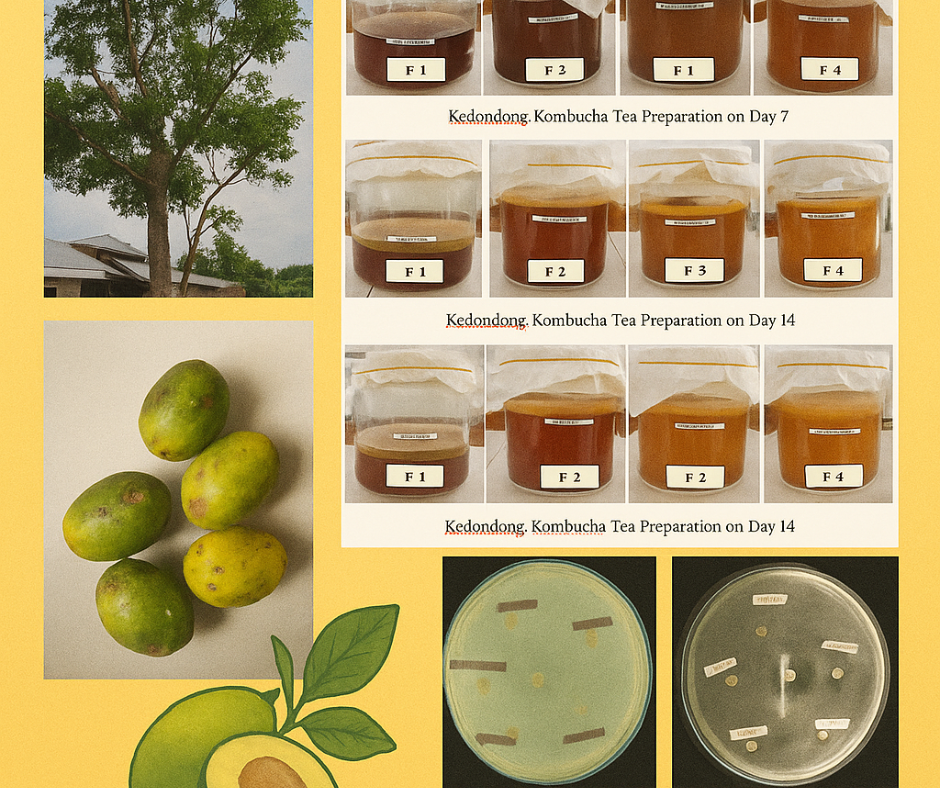
Kombucha tea is a traditional fermented beverage known for its probiotic benefits, produced from sweetened tea fermented with a Symbiotic Culture of Bacteria and Yeast (SCOBY). Recent innovations have focused on enhancing its functional properties using local fruit extracts. However, studies on the incorporation of Spondias dulcis (kedondong), a native fruit of Riau, remain limited. This study aims to formulate kombucha tea enriched with kedondong juice and evaluate its quality and antibacterial activity against Escherichia coli and Staphylococcus aureus. Four formulations were prepared with kedondong juice concentrations of 0% (F1), 10% (F2), 20% (F3), and 30% (F4). Parameters observed included organoleptic properties, pH, alcohol content, microbial growth, and total acidity. Antibacterial activity was tested using the disc diffusion method, and results were statistically analyzed using One-Way ANOVA. F4 on day 7 showed the highest inhibition zones (13.30 mm for E. coli and 14.49 mm for S. aureus), with significant differences between formulations (p < 0.05). This study highlights the potential of kedondong-enriched kombucha tea as a functional probiotic beverage and a natural source of mild antibacterial agents, offering an innovative approach to utilizing local biodiversity in public health.
Downloads
References
Mazni, R. (2008). Antibacterial activity test of ethanol extract of Merremia mammosa tuber against Staphylococcus aureus and Escherichia coli and brine shrimp lethality test [Doctoral dissertation, Universitas Muhammadiyah Surakarta].
Widi, F. N. (2022). Systematic review: Antimicrobial activity of Musa sp. against pathogenic bacteria in vitro [Undergraduate thesis].
Zubaidah, E., Effendi, F. D., & Afgani, C. A. (2022). Kombucha: Microbiology, technology, and health benefits. Universitas Brawijaya Press.
Laavanya, D., Shirkole, S., & Balasubramanian, P. (2021). Current challenges, applications, and future perspectives of SCOBY cellulose from kombucha fermentation. Journal of Cleaner Production, 295, 126454. https://doi.org/10.1016/j.jclepro.2021.126454
Effendi, F., Roswiem, A. P., & Stefani, E. (2014). Antibacterial activity test of probiotic kombucha tea against Escherichia coli and Staphylococcus aureus. Fitofarmaka: Scientific Journal of Pharmacy, 4(2), 1–9.*
Ulfia, Z. (2024). Minimum inhibitory concentration (MIC) of kombucha tea against S. epidermidis at different fermentation times [Doctoral dissertation, Universitas Islam Negeri Ar-Raniry].
Fadhilah, F. R., Pakpahan, S., Rezaldi, F., Kusmiran, E., Cantika, E., Julinda, O., & Muhammad, R. (2024). Antimicrobial potential of torch ginger (Etlingera elatior) kombucha tea. The Indonesian Journal of Infectious Diseases, 10(1), 24–35.*
Rakhmawati, R., & Yunianta, Y. (2015). Effect of fruit-to-water ratio and heating duration on the antioxidant activity of ambarella fruit juice (Spondias dulcis). Journal of Food and Agroindustry, 3(4), 1682–1693.*
Nasution, M. R., Utami, R., Tinnisa, N., Febriyananda, A., & Maisarah, M. (2024). Principles of kombucha research analysis (based on literature review). Tangguh Denara Jaya Publisher.
Sukma, N. (2008). Antibacterial effectiveness test of ethanol extract of ambarella (Spondias dulcis Soland ex Park) stem bark and fruit flesh against Staphylococcus aureus ATCC-25923 using disk diffusion method [Undergraduate thesis, Universitas Muhammadiyah Pekalongan].
Yulvizar, C. (2013). Identification of probiotic bacteria in Rastreligger sp. Biospecies Journal, 6(2), 1–7.*
Aristya, A. L., Legowo, A. M., & Al-Baarri, A. N. (2013). Total acid, total yeast, and protein profile of goat milk kefir with different types and concentrations of sugar. Journal of Food and Nutrition, 4(7), 39–48.*
Ayuratri, M. K., & Kusnadi, J. (2017). Antibacterial activity of ginger kombucha (Zingiber officinale): A study of ginger varieties and honey concentrations. Journal of Food and Agroindustry, 5(3), 95–107.*
Ivanišová, E., Meňhartová, K., Terentjeva, M., Harangozo, Ľ., Kántor, A., & Kačániová, M. (2020). The evaluation of chemical, antioxidant, antimicrobial and sensory properties of kombucha tea beverage. Journal of Food Science and Technology, 57(5), 1840–1846.* https://doi.org/10.1007/s13197-019-04201-0
Clinical and Laboratory Standards Institute (CLSI). (2020). Performance standards for antimicrobial susceptibility tests: Approved standard (11th ed.). CLSI.
Bhattacharya, D., Bhattacharya, S., Patra, M. M., Chakravorty, S., Sarkar, S., Chakraborty, W., & Gachhui, R. (2016). Antibacterial activity of polyphenolic fraction of kombucha against enteric bacterial pathogens. Current Microbiology, 73(6), 885–896.* https://doi.org/10.1007/s00284-016-1127-5
Shahbazi, H., Hashemi Gahruie, H., Golmakani, M. T., Eskandari, M. H., & Movahedi, M. (2018). Effect of medicinal plant type and concentration on physicochemical, antioxidant, antimicrobial, and sensorial properties of kombucha. Food Science & Nutrition, 6(8), 2568–2577.* https://doi.org/10.1002/fsn3.855
Handito, D., & Amaro, M. (2021). Effect of SCOBY (symbiotic culture of bacteria and yeast) starter concentration on total microbes, total yeast, and organoleptic properties of apple juice kombucha. Pro Food, 7(2), 12–22.*
Nadhiroh, H. (2018). Effect of fermentation time and moringa leaf (Moringa oleifera) concentration on the characteristics of moringa leaf kefir water [Doctoral dissertation, Universitas Islam Negeri Maulana Malik Ibrahim].
Sulistiawaty, L., & Solihat, I. (2022). Kombucha: Physicochemical and critical study on halal level. Warta Akab, 46(1), 1–8.*
Codex Alimentarius Commission. (2003). Codex standard for fermented milks (Codex STAN 243). FAO/WHO Food Standards.
Downloads
Published
How to Cite
Issue
Section
License
Copyright (c) 2025 Musyirna Rahmah Nasution, Agfa Febriyananda

This work is licensed under a Creative Commons Attribution-NonCommercial-ShareAlike 4.0 International License.
Authors who publish with ACA: Acta Chimica Asiana agree to the following terms:
- Authors retain copyright and grant the journal right of first publication with the work simultaneously licensed under a Creative Commons Attribution-NonCommercial-ShareAlike 4.0 International License. This license allows authors to use all articles, data sets, graphics, and appendices in data mining applications, search engines, web sites, blogs, and other platforms by providing an appropriate reference. The journal allows the author(s) to hold the copyright without restrictions and will retain publishing rights without restrictions.
- Authors are able to enter into separate, additional contractual arrangements for the non-exclusive distribution of the journal's published version of the work (e.g., post it to an institutional repository or publish it in a book), with an acknowledgement of its initial publication in ACA: Acta Chimica Asiana.
- Authors are permitted and encouraged to post their work online (e.g., in institutional repositories or on their website) prior to and during the submission process, as it can lead to productive exchanges, as well as earlier and greater citation of published work (See The Effect of Open Access).



 Indonesian Chemical Society, Chapter Nusa Tenggara. Jalan Majapahit 62 Mataram, University of Mataram, 83125, Indonesia