
Optimization of microwave irradiation time for KOH-activated carbon from oil palm fronds
DOI:
https://doi.org/10.29303/aca.v8i2.275Keywords:
Activated Carbon, Microwave, Oil Palm Fronds.Abstract
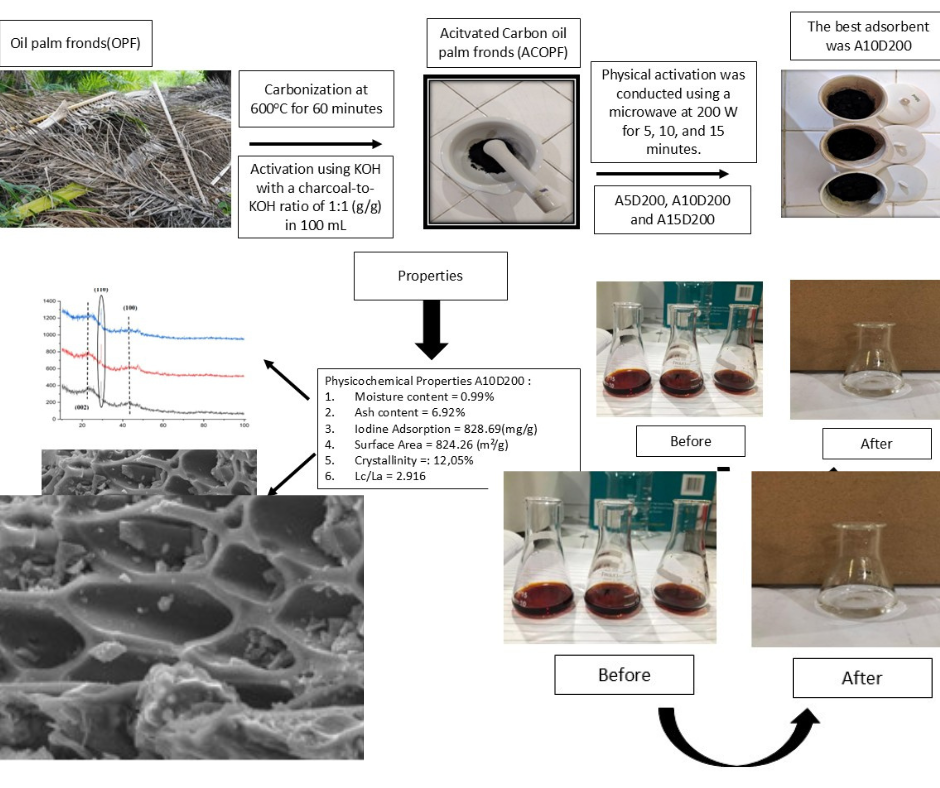
Activated carbon is a widely applied adsorbent material in wastewater treatment, whose physical and chemical properties are strongly influenced by the activation method employed. Microwave irradiation–based physical activation has emerged as an attractive alternative, offering shorter processing times and lower energy consumption compared to conventional heating methods. This study aims to evaluate the effect of varying microwave irradiation times on the characteristics of activated carbon derived from oil palm fronds (OPF) waste. The synthesis process began with carbonization at 600 °C for 60 minutes to produce OPF char, followed by chemical activation using KOH with a char-to-KOH mass ratio of 1:1 (g/g) in 100 mL of demineralized water, and subsequently physical activation using a microwave at 200 W for 5 minutes (A5D200), 10 minutes (A10D200), and 15 minutes (A15D200). Characterization was conducted in accordance with SNI 06-3730-1995 standards (moisture content, ash content, and iodine adsorption capacity), as well as physicochemical analyses including crystallinity, surface area, functional groups, morphology, and elemental composition. The results demonstrated that all samples met the SNI requirements, with the highest iodine adsorption capacity (828.69 mg/g) and the largest surface area (824.26 m²/g) obtained at A10D200. XRD analysis revealed the dominance of amorphous structures with an increasing Lc/La ratio as the irradiation time increased, while SEM images showed relatively small and uniformly distributed pores. FTIR spectra confirmed the presence of O–H, C=O, C=C, C–H, and C–O functional groups. In conclusion, a 10-minute irradiation time produced activated carbon with an optimal balance between pore structure, surface area, and adsorption capacity
Downloads
References
Syafrani, S., Purnama, I., Mutamima, A., & Dewi, W. N. (2022). Study on the commitment of oil palm companies to achieve sustainable agriculture in Riau Province from the perspective of pesticide use. IOP Conference Series: Earth and Environmental Science, 1041(1), 012038. https://doi.org/10.1088/1755-1315/1041/1/012038
Ismiasih, I., & Afroda, H. (2023). Faktor penentu produksi kelapa sawit rakyat di Provinsi Riau. Jurnal Penelitian Pertanian Terapan, 23(3), 211–218.
Yaro, N. S. A., Napiah, M. Bin, Sutanto, M. H., Usman, A., & Saeed, S. M. (2021). Modeling and optimization of mixing parameters using response surface methodology and characterization of palm oil clinker fine modified bitumen. Construction and Building Materials, 298, 123849. https://doi.org/10.1016/j.conbuildmat.2021.123849
Jafri, N. H. S., Jimat, D. N., Azmin, N. F. M., Sulaiman, S., & Nor, Y. A. (2021). The potential of biomass waste in Malaysian palm oil industry: A case study of Boustead Plantation Berhad. IOP Conference Series: Materials Science and Engineering, 1192(1), 012028. https://doi.org/10.1088/1757-899X/1192/1/012028
Hassan, M. A., Farid, M. A. A., Zakaria, M. R., Ariffin, H., Andou, Y., & Shirai, Y. (2024). Palm oil expansion in Malaysia and its countermeasures through policy window and biorefinery approach. Environmental Science & Policy, 153, 103671. https://doi.org/10.1016/j.envsci.2024.103671
Zikri, R., Natasyah, E., & Muhdarina, M. (2022). Synthesis of oil palm fronds charcoal as adsorbent to reduce levels of Fe (III) in peat water. Jurnal Kimia Sains dan Aplikasi, 25(8), 300–306. https://doi.org/10.14710/JKSA.25.8.300-306
Sultana, M., Rownok, M. H., Sabrin, M., Rahaman, M. H., & Alam, S. M. N. (2022). A review on experimental chemically modified activated carbon to enhance dye and heavy metals adsorption. Cleaner Engineering and Technology, 6, 100382. https://doi.org/10.1016/j.clet.2021.100382
Gayathiri, M., Pulingam, T., Lee, K. T., & Sudesh, K. (2022). Activated carbon from biomass waste precursors: Factors affecting production and adsorption mechanism. Chemosphere, 294, 133764. https://doi.org/10.1016/j.chemosphere.2022.133764
Jagaba, A. H., Kutty, S. R. M., Hayder, G., Baloo, L., Noor, A., Yaro, N. S. A., et al. (2021). A systematic literature review on waste-to-resource potential of palm oil clinker for sustainable engineering and environmental applications. Materials, 14(16), 4456. https://doi.org/10.3390/ma14164456
Deraman, M., Kumar, H. S., Shamsudin, S. A., Rosli, M. I., Omar, F. S., Othman, M. A. R., et al. (2025). Effect of electrode thickness on capacitive and self-discharge performance of carbon-based supercapacitor. Key Engineering Materials, 1007, 51–62.
Natasyah, E. (2020). Sintesis dan karakterisasi karbon aktif dari limbah pelepah kelapa sawit (Elaeis guineensis Jacq.) menggunakan pengaktif kalium hidroksida [Undergraduate thesis, Universitas Riau].
Zikri, R. (2024). Sintesis komposit karbon aktif pelepah kelapa sawit–magnetit (Fe₃O₄) dengan variasi mol pengendap NaOH sebagai katalis pendegradasi metilen biru [Undergraduate thesis, Universitas Riau].
Udyani, K., & Purwaningsih, D. Y. (2021). Chemical and physical activation using a microwave to increase the ability of activated carbon to adsorb dye waste. Journal of Physics: Conference Series, 2117(1), 012030. https://doi.org/10.1088/1742-6596/2117/1/012030
Widanarto, W., Budianti, S. I., Ghoshal, S. K., Kurniawan, C., Handoko, E., & Alaydrus, M. (2022). Improved microwave absorption traits of coconut shells-derived activated carbon. Diamond and Related Materials, 126, 109059.
Kopac, T., & Lin, S. D. (2024). A review on the characterization of microwave-induced biowaste-derived activated carbons for dye adsorption. International Journal of Environmental Science and Technology, 21, 8717–8748. https://doi.org/10.1007/s13762-024-05583-y
Duran-Jimenez, G., Rodriguez, J., Stevens, L., Altarawneh, S., Batchelor, A., Jiang, L., et al. (2024). Single-step preparation of activated carbons from pine wood, olive stones and nutshells by KOH and microwaves: Influence of ultra-microporous for high CO₂ capture. Chemical Engineering Journal, 499, 156135.
Komariyah, D. (2021). Karbonisasi-aktivasi KOH/microwave pelepah kelapa sawit (Elaeis guineensis Jacq.) menjadi karbon aktif untuk mengurangi warna dan kekeruhan dalam limbah cair pabrik kelapa sawit [Undergraduate thesis, Universitas Riau].
Wahyuni, S. (2021). Karbonisasi-aktivasi KOH/microwave pelepah kelapa sawit menjadi karbon aktif untuk mengurangi TDS dari limbah cair pabrik kelapa sawit [Undergraduate thesis, Universitas Riau].
Taufik, M., Suci, T., Kasih, D., & Khair, M. (2021). Pembuatan karbon aktif cangkang kelapa sawit (Elaeis guineensis) dengan aktivator gelombang microwave. Chemistry Journal Universitas Negeri Padang, 10(1), 40–44.
Zalmi, H., & Khair, M. (2021). Sintesis dan karakterisasi karbon aktif dari ampas tebu diaktivasi menggunakan gelombang mikro. Jurnal Periodik Jurusan Kimia Universitas Negeri Padang, 10(1), 38.*
Sembiring, C. H., Husnah, M., & Sirait, R. (2023). Preparasi karbon aktif limbah kulit ubi kayu menggunakan aktivasi NaOH berbantuan gelombang mikro. Jurnal Online Fisika, 8(1), 33–38.*
Nandi, R., Jha, M. K., Guchhait, S. K., Sutradhar, D., & Yadav, S. (2023). Impact of KOH activation on rice husk-derived porous activated carbon for carbon capture at flue gas alike temperatures with high CO₂/N₂ selectivity. ACS Omega, 8(6), 4802–4812.* https://doi.org/10.1021/acsomega.2c06470
Purnamawati, N. (2023). Uji kualitas sintesis karbon aktif dari pelepah aren teraktivasi asam fosfat. Journal of Research and Education in Chemistry, 5(2), 120.*
Qodir, M. A., Alhikami, A. F., & Margianto, M. (2025). Analisis profil degradasi massa pada hydrochar menggunakan teknik hydrothermal carbonization dari limbah tandan kosong sawit. Jurnal Teknik Mesin, 22(1), 14–20.*
Kasandra Maidayanti, K. (2021). Efektivitas arang aktif dari limbah tatal karet sebagai media filtrasi untuk penurunan parameter pH, warna dan zat organik pada air gambut [Undergraduate thesis].
Debbache, H., Amor, A. A., Amor, F. Z. A., Khiari, R., Moussaoui, Y., Belfar, M. L., et al. (2024). A comprehensive analysis of the use of chemical activation technology to produce activated carbon from agricultural residues. Cellulose Chemistry and Technology, 58(9–10), 1149–1161.*
Awitdrus, Siregar, G. M. G., Agustino, Saktioto, Iwantono, Syahputra, R. F., et al. (2021). KOH activation with microwave irradiation and its effect on the physical properties of orange peel activated carbon. Journal of Physics: Conference Series, 2049(1), 012025.* https://doi.org/10.1088/1742-6596/2049/1/012025
Fajri, R. J. (2024). Pemanfaatan limbah kulit kopi arabika (Coffea arabica) menjadi karbon aktif sebagai adsorben zat warna metilen biru [Undergraduate thesis].
Addzikri, A. I., & Rosariawari, F. (2025). Pemanfaatan ampas tebu dan kulit pisang kepok sebagai karbon aktif pada proses adsorpsi untuk menyisihkan kadar Fe dan Mn. Jurnal Serambi Engineering, 10(1).*
Febriani, A. V., Hanum, F. F., Rahayu, A., Wardhana, B. S., & Chusna, F. M. A. (2025). The impact of carbonization temperature on the quality of empty fruit bunch charcoal and palm kernel charcoal for co-firing application. Sains Natural: Jurnal Biologi dan Kimia, 15(1), 28–39.*
Niswah, F. S., Yasa, I. W. S., & Nofrida, R. (2025). Pengaruh suhu dan lama penyangraian biji kakao terhadap karakteristik mutu teh kulit biji kakao (Theobroma cacao L.). Jurnal Edukasi Pangan, 3(1), 58–71.*
Kusniawati, E., Sari, D. K., & Putri, M. K. (2023). Pemanfaatan sekam padi sebagai karbon aktif untuk menurunkan kadar pH, turbidity, TSS, dan TDS. Journal of Innovation Research and Knowledge, 2(4), 4183–4198.*
Ayuningtias, F. S. (2023). Pemanfaatan limbah cangkang kelapa sawit (Elaeis guineensis Jacq.) menjadi arang aktif tahun 2023 [Undergraduate thesis].
Hardiansyah, M. F. (2024). Sintesis dan karakterisasi mikro-karbon dari selulosa limbah kulit ubi jalar (Ipomoea batatas) menggunakan metode microwave-assisted hydrothermal carbonization [Undergraduate thesis].
Kim, S., Lee, S.-E., Baek, S.-H., Choi, U., & Bae, H.-J. (2023). Preparation of activated carbon from Korean anthracite: Simultaneous control of ash reduction and pore development. Processes, 11(8), 2877.*
Ibrahim, P. P., Husain, R., & Lantu, I. S. (2025). Effect of soaking volume using pineapple peel waste vinegar on the yield, viscosity, moisture, and ash content of gelatin from tuna bone (Thunnus sp.). Jurnal Ilmiah PLATAX, 13(2), 324–334.*
Astuti, C. S., Azmi, Y., & Febrianti, F. (2024). Pembuatan arang aktif kultur jaringan dari pelepah kelapa sawit (Elaeis guineensis Jacq.) dengan berbagai aktivator. Jurnal Ilmiah Respati, 15(2), 214–225.*
Trisunaryanti, W., Triyono, T., Falah, I. I., Wicaksono, D. B., & Sumbogo, S. D. (2024). Characteristic and performance of Ni, Pt, and Pd monometal and Ni–Pd bimetal onto KOH activated carbon for hydrotreatment of castor oil. Indonesian Journal of Chemistry, 24(1), 115–124.*
Monika, I., Umar, D. F., Suganal, & Wijayanti, R. (2024). Porous structure improvement of coal activated carbon using steam activation in pilot scale. In AIP Conference Proceedings (Vol. 3003, p. 020026). AIP Publishing LLC.
Ateş, A. (2023). The effect of microwave and ultrasound activation on the characteristics of biochar produced from tea waste in the presence of H₃PO₄ and KOH. Biomass Conversion and Biorefinery, 13(18), 9075–9094.* https://doi.org/10.1007/s13399-021-01838-7
Aloud, S. S., Alharbi, H. A., Hameed, B. H., Giesy, J. P., Almady, S. S., & Alotaibi, K. D. (2023). Production of activated carbon from date palm stones by hydrothermal carbonization and microwave-assisted KOH/NaOH mixture activation for dye adsorption. Scientific Reports, 13, 19064. https://doi.org/10.1038/s41598-023-45641-7
Ahmad, A. A., Al-Raggad, M., & Shareef, N. (2021). Production of activated carbon derived from agricultural by-products via microwave-induced chemical activation: A review. Carbon Letters, 31(6), 957–971. https://doi.org/10.1007/s42823-021-00273-z
Adame-Pereira, M., Alexandre-Franco, M., Fernández-González, C., & Gómez-Serrano, V. (2021). Adsorption of bisphenol A by activated carbon developed from PET by KOH activation. [Journal name unavailable].
Nguyen, H. M., Tran, A. T., Nguyen, D. N. L., Lam, H. H., Tran-Thuy, T.-M., Nguyen, L. Q., et al. (2023). One-pot fabrication of zero-valent iron-embedded activated carbon from rosemary distillation residues for malachite green removal. Materials Research Express, 10(8), 085603. https://doi.org/10.1088/2053-1591/acf09d
Zikri, R., Natasyah, E., & Muhdarina, M. (2022). Synthesis of oil palm fronds charcoal as adsorbent to reduce levels of Fe (III) in peat water. Jurnal Kimia Sains dan Aplikasi, 25(8), 300–306. https://doi.org/10.14710/JKSA.25.8.300-306
Opoku, B. K., Isaac, A., Micheal, A. A., Bentum, J. K., & Muyoma, W. P. (2021). Characterization of chemically activated carbons produced from coconut and palm kernel shells using SEM and FTIR analyses. American Journal of Applied Chemistry, 9(3), 90–96.*
Wang, H., He, T., Hao, X., Huang, Y., Yao, H., Liu, F., et al. (2022). Moisture adsorption–desorption full-cycle power generation. Nature Communications, 13, 2524. https://doi.org/10.1038/s41467-022-30277-y
Kunusa, W. R., Iyabu, H., & Abdullah, R. (2021). FTIR, SEM and XRD analysis of activated carbon from sago wastes using acid modification. Journal of Physics: Conference Series, 1968(1), 012014. https://doi.org/10.1088/1742-6596/1968/1/012014
Ateş, A. (2023). The effect of microwave and ultrasound activation on the characteristics of biochar produced from tea waste in the presence of H₃PO₄ and KOH. Biomass Conversion and Biorefinery, 13(18), 9075–9094. https://doi.org/10.1007/s13399-021-01838-7
Shuaib, M. M., Musah, M., & Mathew, J. T. (2024). Preparation and characterization of activated carbon from Africa star apple (Chrysophyllum albidum) seed shell. FUDMA Journal of Science, 8(3), 194–199. https://doi.org/10.33003/fjs-2024-0803-2485
Jawed, A., Saxena, V., & Pandey, L. M. (2020). Engineered nanomaterials and their surface functionalization for the removal of heavy metals: A review. Journal of Water Process Engineering, 33, 101009. https://doi.org/10.1016/j.jwpe.2019.101009
Chen, J., Li, X., Gao, L., Guo, S., & He, F. (2024). Microwave treatment of minerals and ores: Heating behaviors, applications, and future directions. Minerals, 14(3), 219. https://doi.org/10.3390/min14030219
Lawtae, P., & Tangsathitkulchai, C. (2021). A new approach for controlling mesoporosity in activated carbon by the consecutive process of air oxidation, thermal destruction of surface functional groups, and carbon activation (the OTA method). Molecules, 26(9), 2758. https://doi.org/10.3390/molecules26092758
Lan, D., Zhu, H., Zhang, J., Li, S., Chen, Q., Wang, C., et al. (2022). Adsorptive removal of organic dyes via porous materials for wastewater treatment in recent decades: A review on species, mechanisms, and perspectives. Chemosphere, 293, 133464. https://doi.org/10.1016/j.chemosphere.2021.133464
He, H., Zhang, R., Zhang, P., Wang, P., Chen, N., Qian, B., et al. (2023). Functional carbon from nature: Biomass-derived carbon materials and the recent progress of their applications. Advanced Science, 10(8), 2205557. https://doi.org/10.1002/advs.202205557
Ozcan, D. O., Hendekçi, M. C., & Ovez, B. (2024). Enhancing the adsorption capacity of organic and inorganic pollutants onto impregnated olive stone-derived activated carbon. Heliyon, 10(9), e32792. https://doi.org/10.1016/j.heliyon.2024.e32792
Downloads
Published
How to Cite
Issue
Section
License
Copyright (c) 2025 Rahmat Zikri, Ayu Sapitri, Yolanda Rati

This work is licensed under a Creative Commons Attribution-NonCommercial-ShareAlike 4.0 International License.
Authors who publish with ACA: Acta Chimica Asiana agree to the following terms:
- Authors retain copyright and grant the journal right of first publication with the work simultaneously licensed under a Creative Commons Attribution-NonCommercial-ShareAlike 4.0 International License. This license allows authors to use all articles, data sets, graphics, and appendices in data mining applications, search engines, web sites, blogs, and other platforms by providing an appropriate reference. The journal allows the author(s) to hold the copyright without restrictions and will retain publishing rights without restrictions.
- Authors are able to enter into separate, additional contractual arrangements for the non-exclusive distribution of the journal's published version of the work (e.g., post it to an institutional repository or publish it in a book), with an acknowledgement of its initial publication in ACA: Acta Chimica Asiana.
- Authors are permitted and encouraged to post their work online (e.g., in institutional repositories or on their website) prior to and during the submission process, as it can lead to productive exchanges, as well as earlier and greater citation of published work (See The Effect of Open Access).



 Indonesian Chemical Society, Chapter Nusa Tenggara. Jalan Majapahit 62 Mataram, University of Mataram, 83125, Indonesia