
Physically activated corn cob carbon for congo red and methanil yellow removal
DOI:
https://doi.org/10.29303/aca.v8i2.272Keywords:
corncob, activated carbon, dye adsorption, wastewater treatmentAbstract
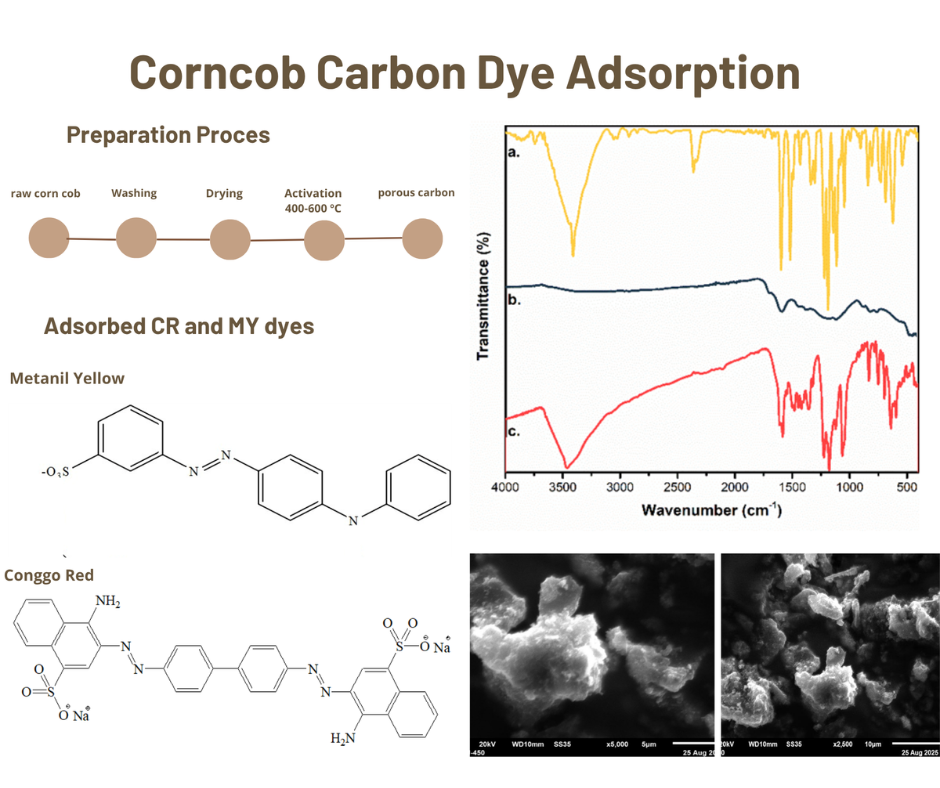
The conversion of agricultural residues into sustainable adsorbents provides an environmentally responsible pathway for advanced wastewater treatment. In this work, physically activated carbon was synthesized from corncob, an abundant and underutilized agricultural byproduct, through carbon dioxide activation at elevated temperatures. Comprehensive characterization using BET surface area analysis, SEM-EDX, and FTIR confirmed the formation of a highly porous structure with abundant surface functional groups, favourable for dye adsorption. The adsorbent exhibited excellent performance in removing Congo Red (CR) and Metanil Yellow (MY), achieving maximum adsorption capacities of 59.88 mg/g and 30.47 mg/g, respectively. The Langmuir isotherm provides a good description of the equilibrium data, while the kinetic results follow the pseudo-second-order model, indicating that monolayer chemisorption is the dominant mechanism. These findings underscore the potential of corncob-derived activated carbon as a cost-effective, renewable, and high-performance material for sustainable wastewater remediation
Downloads
References
Islam, M. M., Aidid, A. R., Mohshin, J. N., Mondal, H., Ganguli, S., & Chakraborty, A. K. (2025). A critical review on textile dye-containing wastewater: Ecotoxicity, health risks, and remediation strategies for environmental safety. Cleaner Chemical Engineering, 100165. https://doi.org/10.1016/j.clce.2025.100165
Zainudin, N. F., Sam, S. T., Wong, Y. S., Ismail, H., Walli, S., Inoue, K., ... & Tan, W. K. (2023). Degradation of diazo Congo red dye by using synthesized poly-ferric-silicate-sulphate through Co-polymerization process. Polymers, 15(1), 237. https://doi.org/10.3390/polym15010237.
Putri, N. P., Riska, A. M., Kusumawati, D. H., & Suaebah, E. (2025). Enhanced Photocatalytic Degradation of Congo Red Dye Using Green-Synthesized TiO₂ and PANI/TiO₂ with Papaya Leaf as Bio-Reduction. Trends in Sciences, 22(2), 9119-9119. https://doi.org/10.48048/tis.2025.9119.
Yahia, Y., Rashid, K. T., Shehab, M. A., Razak, A. A. A., Ghadhban, M. Y., Al-Lami, M., ... & Mahmood, A. (2025). Treating wastewater contaminated with congo red (CR) dye using an optimized polyethersulfone/propolis (bee glue) PES/PRS ultrafiltration membrane. RSC advances, 15(29), 23174. DOI: 10.1039/D5RA03565A
Strebel, A., Behringer, M., Hilbig, H., Machner, A., & Helmreich, B. (2024). Anionic azo dyes and their removal from textile wastewater through adsorption by various adsorbents: a critical review. Frontiers in Environmental Engineering, 3, 1347981. https://doi.org/10.3389/fenve.2024.1347981.
Yang, N., Ma, J., Shi, J., Yang, X., & Lu, J. (2022). Manipulate the nano-structure of layered double hydroxides via calcination for enhancing immobilization of anionic dyes on collagen fibers. Journal of Colloid and Interface Science, 610, 182-193. https://doi.org/10.1016/j.jcis.2021.12.030
Hendronursito, Y., Astuti, W., Sabarman, H., & Santoso, I. (2025). A porous activated carbon derived from banana peel by hydrothermal activation two-step methods. International Journal of Renewable Energy Development, 14(2), 322-331. https://doi.org/10.61435/ijred.2025.60847
Zhang, N., Wang, F., Nwamba, M. C., Wang, D., & Hong, J. (2023). Enhancing tolerance of Kluyveromyces marxianus to lignocellulose-derived inhibitors and its ethanol production from corn cob via overexpression of a nitroreductase gene. Industrial Crops and Products, 203, 117136. https://doi.org/10.1016/j.indcrop.2023.117136
Sun, W., Liu, C., Liu, S., Zhang, J., Chen, H., & Qiu, Z. (2025). Effective adsorption of Congo red by an innovative biochar/LDH-derived MIL-100 (Al): Investigation of coexisting pollutants and mechanism revelation. Separation and Purification Technology, 359, 130670. https://doi.org/10.1016/j.seppur.2024.130670.
Al-Lami, H. S., Abdulwahid, A. A., & Mizhir, A. A. (2022). Adsorption process for removing hazardous Congo red dye from aqueous solutions: isotherm, kinetic, and thermodynamic studies. Desalination and Water Treatment, 280, 177-187. https://doi.org/10.5004/dwt.2022.29114.
Kulkarni, K., Kumar, P. M., Kulkarni, A., & Satpute, S. (2024). Bioremediation of hazardous Metanil yellow dye by using Trichoderma and Azotobacter biofertilizers. Ecological Frontiers, 44(3), 605-617. https://doi.org/10.1016/j.chnaes.2023.11.007.
Sholehah, F., Taba, P., Hala, Y., & Bahrun. (2021, September). Adsorption of congo red dyes using mesoporous silica MCM-48. In AIP Conference Proceedings (Vol. 2360, No. 1, p. 050013). AIP Publishing LLC. https://doi.org/10.1063/5.0059490.
He, X., Chen, X., Wang, X., & Jiang, L. (2023). Optimization of activated carbon production from corn cob using response surface methodology. Frontiers in Environmental Science, 11, 1105408. https://doi.org/10.3389/fenvs.2023.1105408.
Hamed, S. M., Samir, N., Atrees, M., & Abdelbasier, A. M. (2025). Kinetic Pathways for Uranium Adsorption from Contaminated Wastewater Using Activated Carbon Derived from Corn Cob as a Biosorbent. Egyptian Journal of Chemistry, 68(11), 25-40. Doi 10.21608/ejchem.2025.389268.11821.
Akande, J. A., Adeogun, A. I., & Uzosike, A. S. (2023). Removal of congo red dye from simulated wastewater using activated carbon derived from corn cobs; kinetics and equilibrium studies. Glob J Pure Appl Chem Res, 11, 1-19. https://doi.org/10.37745/gjpacr.2023/vol11n1119.
Raghavendra, N., Hublikar, L. V., Sowmyashree, A. S., Nandan, K. R., Tubaki, A. B., Madiwalar, S. S., & Pudakalkatti, S. M. (2025). Fabrication of agro–waste corn cob–derived adsorbent for effective removal of oxalic acid from water: Pollution reducing and energy saving strategy for the wastewater treatment. Next Materials, 8, 100844. https://doi.org/10.1016/j.nxmate.2025.100844
Ojedokun, A. T., & Bello, O. S. (2017). Liquid phase adsorption of Congo red dye on functionalized corn cobs. Journal of Dispersion Science and Technology, 38(9), 1285-1294. https://doi.org/10.1080/01932691.2016.1234384
Sime, T., Fito, J., Nkambule, T. T., Temesgen, Y., & Sergawie, A. (2023). Adsorption of Congo red from textile wastewater using activated carbon developed from corn cobs: the studies of isotherms and kinetics. Chemistry Africa, 6(2), 667-682. https://doi.org/10.1007/s42250-022-00583-2
Zein, R., Chaidir, Z., Zilfa, Z., Fauzia, S., & Ramadhani, P. (2022). Isotherm and kinetic studies on the adsorption behavior of metanil yellow dyes onto modified shrimp shell-polyethylenimine (SS-PEI). Jurnal Kimia Valensi, 8(1), 10-22. DOI:10.15408/jkv.v8i1.22566
Aranda-García, E., Guerrero-Coronilla, I., & Cristiani-Urbina, E. (2024). Water Hyacinth Leaves Are an Efficient, Green, and Cost-Effective Biosorbent for the Removal of Metanil Yellow from Aqueous Solution: Kinetics, Isotherm, and Thermodynamic Studies. Molecules, 29(14), 3409. doi: 10.3390/molecules29143409.
Malviya, A., Jaspal, D. K., & Khamparia, S. (2019). Kinetics studies on the adsorption of Methyl Orange and Metanil Yellow onto bottom ash: a comparative account. Water Science and Technology, 80(10), 1844-1850. https://doi.org/10.2166/wst.2019.435.
Cheng, B., Le, Y., Cai, W., & Yu, J. (2011). Synthesis of hierarchical Ni (OH) 2 and NiO nanosheets and their adsorption kinetics and isotherms to Congo red in water. Journal of hazardous materials, 185(2-3), 889-897. https://doi.org/10.1016/j.jhazmat.2010.09.104.
Arnata, I. W., Suprihatin, S., Fahma, F., Richana, N., & Sunarti, T. C. (2019). Adsorption of anionic congo red dye by using cellulose from sago frond. Poll Res, 38(3), 43-53. https://www.researchgate.net/publication/3366866.
Chanzu, H. A., Onyari, J. M., & Shiundu, P. M. (2019). Brewers’ spent grain in adsorption of aqueous Congo Red and malachite Green dyes: Batch and continuous flow systems. Journal of hazardous materials, 380, 120897. https://doi.org/10.1016/j.jhazmat.2019.120897.
Asnawati, D., Handayani, S. S., Kamali, S. R., Hamdiani, S., Sumarlan, I., Darmayanti, M. G., & Aulia, L. G. (2020). Adsorption of methanyl yellow using activated carbon from kawista fruit shell waste (limonia acidissima l.). Adsorption of methanyl yellow using activated carbon. DOI: 10.29303/jpm.v15i3.1724.
Ramadhani, P. (2019). Biosorbent of pensi shell (Corbicula moltkiana) as an absorbent of metanil yellow dye in terms of pH and adsorption equilibrium model. Journal of Industrial Research and Development. http://dx.doi.org/10.24960/jli.v8i2.4661.
Downloads
Published
How to Cite
Issue
Section
License
Copyright (c) 2025 Faridatun Sholehah; Rabiatul Adawiyah, Bahrun Bahrun

This work is licensed under a Creative Commons Attribution-NonCommercial-ShareAlike 4.0 International License.
Authors who publish with ACA: Acta Chimica Asiana agree to the following terms:
- Authors retain copyright and grant the journal right of first publication with the work simultaneously licensed under a Creative Commons Attribution-NonCommercial-ShareAlike 4.0 International License. This license allows authors to use all articles, data sets, graphics, and appendices in data mining applications, search engines, web sites, blogs, and other platforms by providing an appropriate reference. The journal allows the author(s) to hold the copyright without restrictions and will retain publishing rights without restrictions.
- Authors are able to enter into separate, additional contractual arrangements for the non-exclusive distribution of the journal's published version of the work (e.g., post it to an institutional repository or publish it in a book), with an acknowledgement of its initial publication in ACA: Acta Chimica Asiana.
- Authors are permitted and encouraged to post their work online (e.g., in institutional repositories or on their website) prior to and during the submission process, as it can lead to productive exchanges, as well as earlier and greater citation of published work (See The Effect of Open Access).



 Indonesian Chemical Society, Chapter Nusa Tenggara. Jalan Majapahit 62 Mataram, University of Mataram, 83125, Indonesia